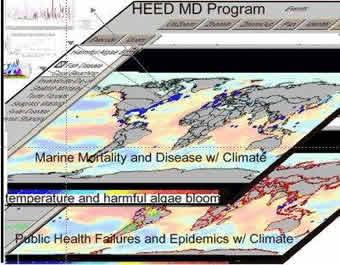

Tracking Mortalities Diseases & Invasive Species

A consequence of history; fragmentation of Earth science information into disciplines of study and separate administrative jurisdictions is incongruent with natural co-evolved processes - phenomena - of ecological and economic importance. Major disturbances, defined as anomalies, are unanticipated because our collective understanding is scattered among a multitude of custodians; effectively lost.

Climate, oceanographic, atmospheric, landscape ecological and economic systems all have one thing in common: Anomalies and system changes can be tracked by observing impacted plants and animals in-turn representing biological proxies for types of disturbance. Assimilation of proxy data to form time series of anomaly observations helps us create the baselines required for subsequent monitoring.(below).
The more we reassemble observational fragments, the more accustomed to disturbance we become, and as such, we are less likely to consider phenomenon anomalous. Civilization can either resist or adapt to disturbance. Adaptation requires the recovery of past anomaly observations and better anticipation of changes by reconstructing place specific disturbance regimes. Characterization of regimes is quick and comparatively less expensive than initiating unprioritized catch-all anomaly monitoring programs. Data reconstruction helps managers better evaluate ecological and economic impacts and is of immediate benefit to epidemiologists under pressure to anticipate future occurrences.

HEED MD Staff Collect metadata to:

-> Recoup prior funded investment

-> Rescue old data to answer new questions

-> Reunify place/time records irrespective of reporter

-> Reconstruct phenomenon indicators using proxies

-> Reuse thematic data for new hypothesis formation

HEED MD Methods include:

-> Mining of the thousands of scholarly publications and government documents relevant to disturbance information for data discovery.

-> Use of canonical semantic keyword associations and neural networks to assist in data recovery.

HEED MD Staff Also:

-> Facilitate training workshops designed to build research consensus and inter-institutional coordination.

-> Develop virtual scientific networks to consolidate observational data and maintain an expert review systems to reconcile disturbance, scale, and quality issues.

-> Consider the use of mass media reports and observational contributions from voluntary observers and the general public to fill gaps in custodial records.

HEED MD products include:

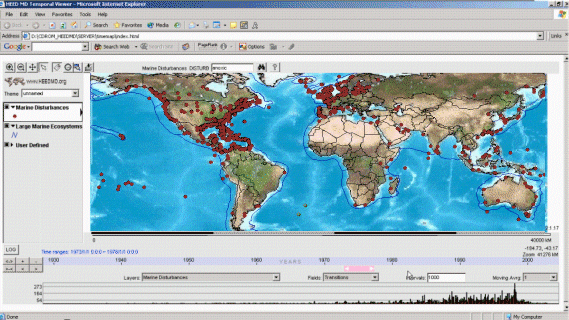
An information system and interface capable of consolidating event reports from a diversity of sources, available here for demonstration purposes only. Training material concentrating on the standardization and organization of historic data combined with assessment of data integrity and coverage. Proposals for future standardization of observation and assimilation systems. A database archive of co-occurring morbidity, mortality, disease and invasive species events.

An ecoindicator framework designed to facilitate an integrated assessment of ecosystem health.

Tracking Harmful Species / Human Health / MMEDs / Disturbance / Wildlife Epidemiology / Zoonoses / Pandemics / Range Changes to develop indices of ecological health


HEED Approach

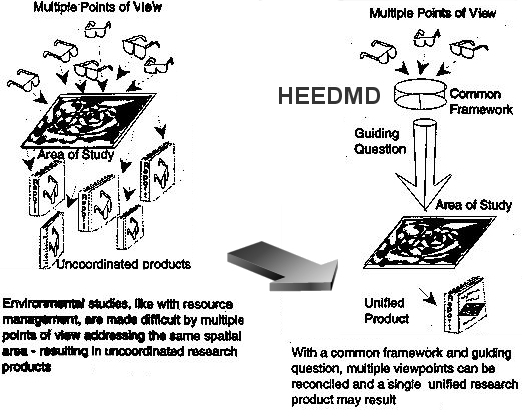
From the perspective of a researcher studying a particular patch of land or seascape, collecting prior research products representing location, time and tracking down other's methods, remains the greatest obstacle in environmental characterization. --- Prior observations form the context for ALL contemporary observation. Recovery of place specific disturbance regimes from the re-assembled information by-products of past studies is possible. One strategy is to focus on meta-data (data about data) and to extract this information from bibliographic archives using keyword searches. This can then direct efforts toward appropriate acquisition of the primary data itself. The literature/metadata mining strategy is expedited through an interdisciplinary process outlined here. The process is designed to be expedient, cost effective, useful to resource managers, and ultimately advances science by helping researchers generate hypotheses.
HEED MD Methods History

All projects share a common methodology formulated as a solution to inefficient interdisciplinary environmental research and hypothesis generation. Extending back to 1988, the methodology was influenced by trial projects at the Univ. of Wisconsin, Madison's LICGF, Environmental Awareness Center, WI State Cartographer's Office and National Park Service CPSU GIS Tech. Center.

The first funded project was the Upper Wyoming Valley Project (Funded by the Center for Biology Education Howard Hughs Medical Endowment in 1989-1990). Additional strategies were field tested during an LTER intrasite experiment at the Northern Temperate Lakes Long Term Ecological Research Network site, then at the Joranada LTER site and then as part of a dissertation project associated with Univ. of Wisconsin Envir. Remote Sensing Center affiliated with the Institute for Environmental Studies Environmental Monitoring Program (1994).

In 1995 the terrestrial and aquatic methods developed in Wisconsin were applied to a Harvard University based NASA/NOAA OGP funded project focused on the interrelationships between human health, marine morbidity mortality and disease, climate forcing and economic impact (HEED Global Change Program)